
On the Kinship Between Russian and West-European Intellectual Traditions - The Salon
In a time when Europe and Russia seem to stand primarily in opposition to one another, it is tempting to think exclusively in terms of polarisation. I deliberately try to step back from that reflexive image of the adversary and instead look at what does connect us, historically and intellectually. The largely forgotten Russian salon culture is one such point of connection: a tradition that shows how ideas, conversation, and cultural exchange do not automatically reduce themselves to geopolitical divides.
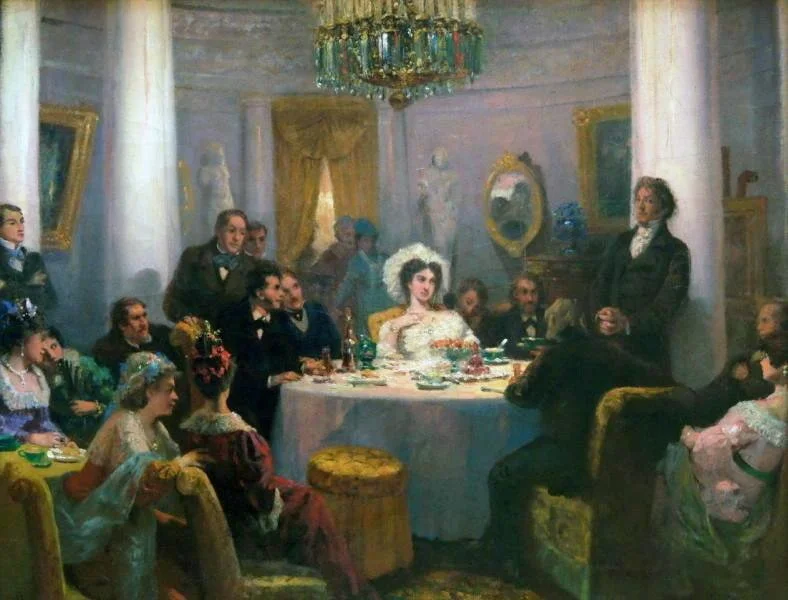
Zinaida Volkonskaya's salon door G.Myasoedov (1904)
The Russian salon made its entrance in the eighteenth century as part of the Westernisation of the aristocracy. The model was French, but the character became unmistakably Russian. In the townhouses of Moscow and Saint Petersburg, writers, musicians, thinkers, and diplomats gathered — not on the basis of lineage, but by invitation. Politics was deliberately kept at the door; literature, art, and ideas took centre stage. In this lies an immediate parallel with West European traditions of civic debate: the salon was a civil space, not a state institution.
Women were the architects of that space. Zinaida Volkonskaya (1789–1862) made her villa on Tverskaya Street the cultural heart of Moscow between 1824 and 1829 (Ostrovsky Museum, n.d.). Alexander Pushkin called her the “queen of the muses and of beauty.” Her salon received, among others, Pushkin himself, the Polish poet Adam Mickiewicz, composers, painters, and intellectuals. She wrote, composed, and sang — not as ornament, but as a full participant. In Saint Petersburg, Avdotya Golitsina built her own circle on Millionnaya Street (Places SPb, n.d.), while in Moscow the salon of Avdotya Yelagina was regarded as an intellectual and moral school for young men (Bondarenko, 2010). Ekaterina Karamzina continued her husband’s literary salon after his death in 1826, until her own death in 1851 (Jeske, 2016).
In this respect, these salons did not differ greatly from their French counterparts led by salonnières such as Madame de Staël or Madame Récamier (Jeske, 2016). There too, the hostess was the cultural director: she determined who was given the floor, which topics came to the table, and which voices lingered. That is a form of leadership, even if it was rarely named as such.
Yet there are clear differences. The French salons were explicitly political and turned against the monarchy; they nourished the revolutionary spirit (Jeske, 2016). The Russian variant remained deliberately cultural, literary, and apolitical. This was not an incidental choice: open political opposition was dangerous. The salon therefore functioned more as a safe space than as a platform for dissent. The Decembrists — a political movement that partly emerged from the same circles — even formally excluded women from their societies (Jeske, 2016).
The salon thus gave women visibility, while simultaneously confirming the boundaries of their role: muse, mother, hostess; rarely author. Their contribution was nonetheless structural. Without the salons, there would have been no Golden Age of Russian literature in this form. The salon served as an intermediary between state patronage and writing as an independent profession — the place where Pushkin read his early work aloud and where literary circles formed that later founded journals and almanacs (Jeske, 2016). The modern Russian literary language was also partly shaped in this setting (Jeske, 2016).
What makes all of this relevant today is not nostalgia, but the underlying model. A woman who creates an intellectual space, carefully selects who sits at the table, and sets the tone of the conversation is still the exception rather than the rule. That this already existed on such a scale in nineteenth-century Russia deserves recognition — not as a curiosity, but as a precedent (Dergipark, 2024).
Mei Mei Fox, "Reviving Salon Culture To Build Community And Encourage Political Discourse," Forbes, 29 november 2017. https://www.forbes.com/sites/meimeifox/2017/11/29/reviving-salon-culture-to-build-community-and-encourage-political-discourse/
"Literary and Musical Salon of Princess Zinaida Volkonskaya," Ostrovsky Museum Moscow. https://ostrovsky-museum.ru/en/page/b7681bf31eff
"Literary Salon of Avdotya Golitsina," Places SPb. https://places.spb.ru/language/English/list/8.html
N.A. Bondarenko, "A.P. Elagina's Salon," Letünk, 2010. http://adattar.vmmi.org/cikkek/1875/letunk_2010.03_05_natalja_alekszandrovna_bondarenko.pdf
Hannah Jeske, "Shaping High Society, Shaping Lives: Russian Salons in the Early Nineteenth Century," University of Florida, 2016. https://ufdcimages.uflib.ufl.edu/AA/00/04/69/26/00001/Honors%20Thesisi_Jeske.pdf
Jeske, ibid. https://ufdcimages.uflib.ufl.edu/AA/00/04/69/26/00001/Honors%20Thesisi_Jeske.pdf
Jeske, ibid. https://ufdcimages.uflib.ufl.edu/AA/00/04/69/26/00001/Honors%20Thesisi_Jeske.pdf
"The Musical Legacy of Princess Zinaida Volkonskaya," Dergipark, 2024. https://dergipark.org.tr/en/download/article-file/5176981
